Elevator and Platform for People with Disabilities
Free movement of population groups with reduced mobility requires specially modified infrastructure. Elevators for people with disabilities are an essential infrastructural element of public space.
Key Features
Safety Certified
EN 81-20/50 compliant with advanced safety systems
Energy Efficient
Class A+ rated systems for maximum efficiency
Premium Quality
European standards with certified components
Design Requirements
Cabin Size
Min 1.1m x 1.4m interior, door 800-900mm, automatic sensor doors
Control Panel
Buttons at 900-1200mm height, Braille markings, audible confirmation
Interior
Handrails ~900mm, rear mirror for navigation, voice floor announcements
Safety
Floor leveling ≤10mm accuracy, low emergency button, visual alarm
External Panel
Low call buttons, sufficient wheelchair maneuvering space
Design Requirements
Our disability elevators comply with international accessibility standards, ensuring safe and comfortable use for everyone.
Cabin Size & Access
- Minimum interior: 1.1 m x 1.4 m for standard wheelchair
- Door width: minimum 800-900 mm
- Automatic sensor doors that stay open during passage
Control Panel
- Buttons positioned at 900-1200 mm from floor level
- Braille markings on all buttons for visually impaired
- High-contrast buttons with audible confirmation
Interior Equipment
- Solid handrails on one or three sides (~900 mm height)
- Rear wall mirror for navigation in small cabins
- Voice announcements: floor number, door open/close
Safety & Precision
- Floor leveling accuracy within 10 mm
- Emergency button accessible at low height
- Visual alarm signal for hearing impaired
External Panel
- Call buttons at wheelchair-accessible height
- Sufficient maneuvering space in front of elevator
- Accessible on all floors
Ideal For
Stair lift or vertical platform lift?
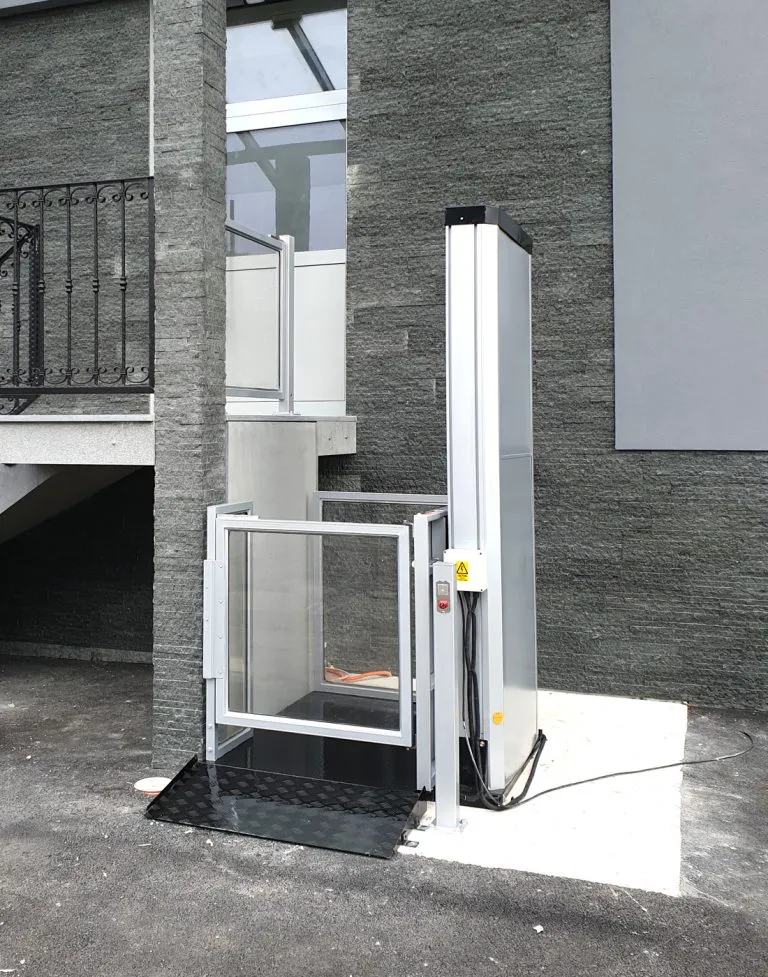
A stair lift, either a chair or an inclined platform, runs on a rail along the staircase. A vertical platform lift rises straight up like a small lift, so a wheelchair user travels without leaving the chair.
WestLift supplies a hydraulic vertical platform lift: 385 kg, a 1100 × 1400 mm platform, up to 3 stops and 6500 mm of travel, with a pit of only 120 mm. It can go in a stairwell, inside the building or on the facade. If you were looking for a stair lift, call us: we will look at the staircase and tell you whether a vertical platform is the better fit.
You Might Also Like
Browse our complete range of elevator solutions
Ready to Install Elevator and Platform for People with Disabilities?
Get a custom quote tailored to your building requirements. Our team of experts is ready to help.
Accessibility Elevators: frequently asked questions
What are the specifications of the platform lift for people with disabilities?
Rated load 385 kg, speed 0.15 m/s, platform 1100 × 1400 mm, outer dimensions 1540 × 1540 mm, a pit of only 120 mm, travel up to 6500 mm with 3 stops, and a 900 × 2000 mm door.
Where can an accessibility lift be installed?
In reception areas, stairwells, inside the building or on an exterior facade — in public spaces, educational and cultural institutions, specialized facilities and private homes.
What happens if the power goes out?
The lift has UPS plus manual emergency rescue, an emergency lighting system and a two-way communication system for safe evacuation.
Which accessibility features are included?
Voice announcements, a floor leveling system, an automatic swing door, an anti-bacterial PVC platform floor, surface-mounted call buttons and an overload system.